Cowplain History: From Forest Hamlet to Modern Suburb
Discover how Cowplain evolved from a medieval woodland clearing into Hampshire's largest post-war housing development.
# Cowplain History: From Forest Hamlet to Modern Suburb
!West Walk in the Forest of Bere — countryside near Cowplain, Hampshire
Tim Sheerman-Chase / Wikimedia Commons
Cowplain's story is one of remarkable transformation. From a small, unnamed clearing in ancient woodland to a thriving suburban village of 15,000–18,000 residents, the area has undergone more change in the past 80 years than in the preceding eight centuries. Understanding Cowplain's history helps explain why it feels the way it does today — and what ties it to the wider Hampshire landscape.
Origins: The Coppice Plain
The name 'Cowplain' likely derives from 'coppice plain' — a cleared area within the Forest of Bere used for woodland management and timber production. This etymology tells us something important: Cowplain was never a natural open settlement, but rather a deliberately managed space within one of England's ancient royal forests.
The Forest of Bere was a significant landholding, stretching across much of this corner of Hampshire. In medieval times, it served as a royal hunting forest — a privilege that meant the land was controlled by the Crown and its use was tightly regulated. Ordinary people lived on its edges; the forest itself belonged to the king. This ancient woodland has shaped the character of the area for over a thousand years, and remnants of it — most notably Queen's Inclosure — remain protected today by Forestry England.
The Victorian Railway Era
For centuries, Cowplain remained a quiet rural hamlet. The first significant disruption came in the 19th century with the arrival of the London & South Western Railway through nearby Havant. Railways were transformative infrastructure, and their impact on small Hampshire villages was immediate.
The rail connection spurred modest residential expansion, particularly along London Road — the main thoroughfare that would eventually become the A3. Commuting became possible for the first time, and a new class of suburban dweller emerged: people who could work in larger towns but live in quieter, semi-rural surroundings. By the end of the Victorian era, Cowplain had begun its slow transition from pure hamlet to village, though it remained small and distinctly rural.
Post-War Transformation: Housing and Education
Nothing, however, prepared Cowplain for what came after 1945.
The Second World War left Portsmouth heavily damaged by aerial bombardment. Thousands of families needed new homes. The solution was ambitious: build large, planned housing estates in the surrounding areas. Cowplain, with its proximity to Portsmouth, vacant land, and existing road access, was identified as ideal.
From the late 1940s onwards, the Leigh Park estate rose on the western side of the area — a vast public housing development that, at its peak, was one of the largest in Europe. Simultaneously, the broader Cowplain locality underwent similar suburban infill. Much of the housing stock that exists today — the semis, detached homes, and bungalows that characterise the village — dates from this period, roughly 1950–1980.
This wasn't random sprawl. It was planned development, driven by genuine housing need. As part of the same post-war expansion, Cowplain School opened in its current form on Durley Avenue, reflecting the educational infrastructure required by a rapidly growing population. Living in Cowplain today means living in a landscape shaped fundamentally by these mid-20th-century decisions.
The transformation was staggering. A place that had been agricultural and forested for centuries became a suburban commuter village within a single generation.
The Leigh Park Story
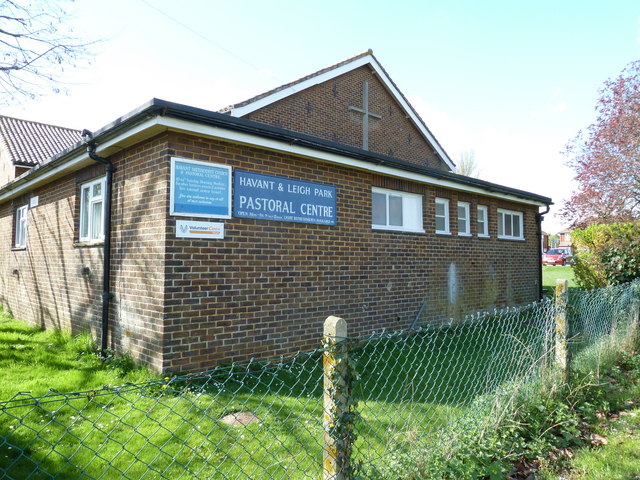
Leigh Park deserves its own mention, because it represents one of Britain's most significant post-war social housing experiments. Built to rehouse Portsmouth families, it became a landmark estate — visible from the A3, with its own distinct character and community identity.
While Leigh Park and Cowplain are technically distinct areas, they are geographically and socially intertwined. Many residents of Cowplain work, shop, or socialise in Leigh Park, and vice versa. The estate transformed from a flagship housing solution into a mixed-tenure area over subsequent decades, reflecting broader trends in British housing policy.
Recent Decades: Commuter Territory
From the 1980s onwards, Cowplain's character shifted again. The area became increasingly owner-occupied, with former council properties purchased under Right to Buy schemes and new owner-occupied developments filling remaining gaps. It evolved into classic commuter territory — a place where people live but often work elsewhere.
The absence of a railway station (the nearest are Havant and Cosham, both around 5 miles away) meant car dependency grew. The A3, running through the heart of Cowplain as London Road, became the vital artery. Bus services provided essential connectivity, but the private car remained king.
Today, Cowplain is firmly suburban. It lacks the historic centre of an old market town, the rural character of a true village, or the urban density of Portsmouth or Southampton. Instead, it is a comfortable, well-established commuter suburb — which suits many people perfectly.
Preserving the Past
Despite its suburban modern character, Cowplain remains rooted in its woodland heritage. Queen's Inclosure — that ancient coppiced woodland immediately east of the village — continues to be managed as forest today. It is a living link to the medieval Forest of Bere and the origins of the settlement itself.
For more information about Cowplain's heritage within the wider context of Hampshire, visit Visit Hampshire or contact Havant Borough Council.
Understanding Cowplain Today
Cowplain's history explains much about life here. It is a place without medieval streets, without grand Victorian architecture, without a railway station — but with excellent road access, good schools, accessible countryside, and affordable housing relative to the South Coast. It is a creation of the 20th century, built to solve a specific problem (housing shortage) in a pragmatic way.
For those considering moving to Cowplain, understanding this history is useful. You're not moving to a quaint historical village with ancient origins — you're moving to a planned, modern suburb with strong community infrastructure and genuine links to its ancient woodland surroundings. That's not a criticism; it's simply what Cowplain is. And for many, it's exactly what they're looking for.
Share this article